In the vast and rapidly changing landscapes of Alaska, a team of dedicated scientists from Northern Arizona University is diligently studying the intricate relationship between escalating wildfires and the thawing of permafrost. Their comprehensive research, which combines rigorous field observations with detailed laboratory analyses, is unveiling crucial information about how these environmental shifts are amplifying climate change by liberating immense reservoirs of trapped carbon. The findings underscore the diverse consequences across various ecological systems and suggest that sudden permafrost melting could hasten global warming more quickly than anticipated. This urgent inquiry into these interconnected climate feedback loops is vital for grasping our planet's future environmental trajectory.
The Arctic's Frozen Carbon Store: A Warming World's Dilemma
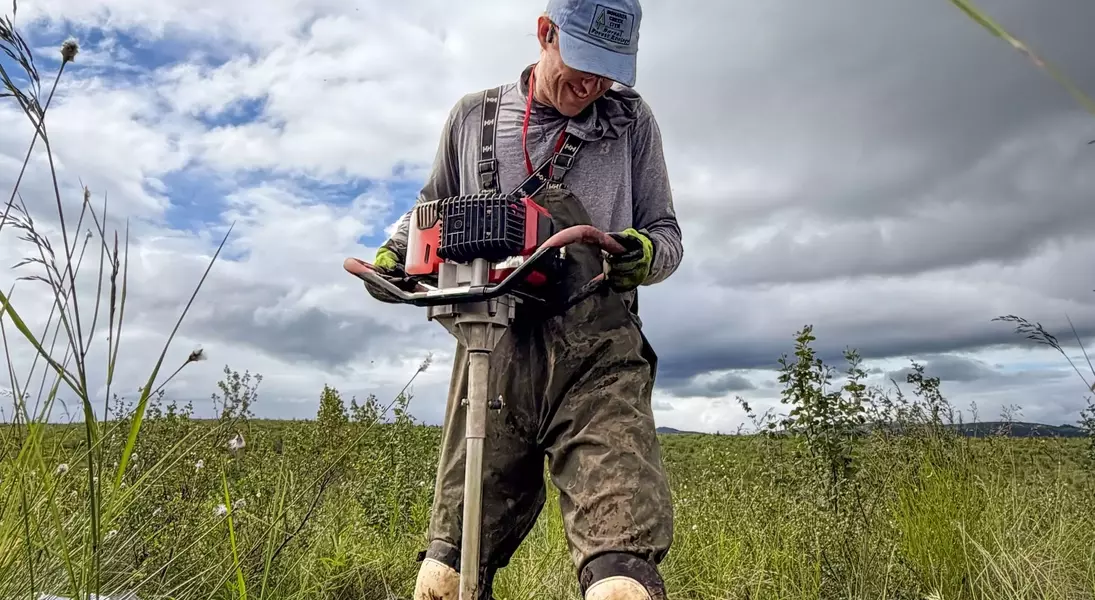
In July, within the vast expanse of Alaska's Denali National Park, Andrew Haverdink, a diligent graduate student, extracted a cylindrical core of ancient, dark permafrost from the stubbornly frozen ground. This sample was a testament to the ongoing research by a Northern Arizona University team, led by principal investigator Xanthe Walker, who were meticulously collecting data from a research plot. This particular site, once a canvas of mostly treeless tundra in the park's northern backcountry, was ravaged by a lightning-sparked fire in June 2013. Fanned by fierce Chinooks, the blaze scorched nearly 35,000 acres, incinerating vegetation and penetrating deep into the topsoil. This destructive event stripped away the crucial insulating layer that protects the permafrost, a massive underground repository holding 85% of Alaska's carbon.
Initial surveys conducted in 2016 revealed a stark reality: in areas most intensely burned, the active layer—the thawed soil above the permafrost—had deepened significantly, extending up to two feet deeper than in unburnt areas. This profound thawing was particularly evident because the fire had intersected survey grids established by the National Park Service in 2001, providing a unique pre-fire baseline for comparison. Walker emphasized the rare opportunity this presented to study the long-term effects of fire on vegetation, carbon dynamics, and permafrost. These direct observations from high-latitude fires are proving invaluable in enhancing our comprehension of how wildfires and permafrost degradation contribute to climate change.
As Arctic-boreal fires become more frequent and severe, and as permafrost continues to thaw, the cascading climate feedback loops intensify. Warmer temperatures ignite more fires, leading to further permafrost thaw, which, in turn, releases potent greenhouse gases such as carbon dioxide and methane. These emissions then exacerbate warming, creating a vicious cycle. Michelle Mack, a professor of ecosystem ecology at Northern Arizona University, and her colleague Ted Schuur have been at the forefront of this research. Their extensive work across Alaska over two decades highlights the complexity of these interactions. The local climate, ecosystem, fire intensity, and permafrost type all play a significant role in determining carbon uptake or loss, the extent of thawing, potential recovery, and future flammability.
For instance, their 2021 study in Science, following large boreal fires in 2004, showed that severe burns in black spruce forests led to a shift towards faster-growing deciduous trees, which absorbed significantly more soil carbon, potentially compensating for initial fire emissions. However, the 2007 Anaktuvuk River tundra fire, the largest recorded fire on Alaska's North Slope, presented a contrasting scenario. This fire released over 2 million tons of carbon, nullifying the annual carbon uptake by tundra ecosystems globally. Subsequent studies revealed that over a third of the scorched landscape collapsed due to melting ice wedges, and nearly two decades later, these areas continue to emit greenhouse gases. Researchers like Adrian Rocha from the University of Notre Dame, who monitors these sites, estimate that recovering the lost carbon could take centuries, if it ever happens at all.
Back in the lab, the team analyzes soil samples from Denali, including permafrost cores. Their initial findings indicate that in severely burned areas, the thawed soil layer above the permafrost remains deeper even after 13 years, exposing more soil to decomposition. The lab work aims to quantify this carbon loss. Looking ahead, Ted Schuur's experimental plots near Healy, Alaska, provide a glimpse into the future. By simulating warmer conditions, his team observed a 23% decline in soil carbon levels over 13 years, with extensive land collapse. Schuur anticipates that permafrost across the entire field will thaw significantly by 2040, a phenomenon that will progressively affect the entire state unless global emissions are drastically cut and wildfires brought under control.
The ongoing research into the Arctic-boreal region's permafrost and wildfire dynamics paints a vivid picture of complex environmental changes and their far-reaching implications. The sheer scale of permafrost carbon storage, far exceeding that in surface vegetation, means that its release could overwhelm any mitigating factors. This critical work underscores the urgency of addressing climate change and managing wildfires to safeguard this fragile yet globally significant ecosystem.
The profound insights gleaned from the Alaskan permafrost research offer a sobering reflection on the interconnectedness of our global climate systems. As a reporter, I find the stark contrast between localized recovery and widespread, irreversible damage particularly striking. It highlights that while nature possesses an incredible capacity for regeneration, there are tipping points beyond which the balance is irrevocably altered. The scientists' dedication to understanding these intricate feedback loops, especially the potential for abrupt permafrost thaw to accelerate warming, serves as a powerful call to action. Their findings are not merely academic data; they are a dire warning that our planet's future hinges on immediate, decisive efforts to curb emissions and mitigate the drivers of climate change. This research compels us to confront the reality that the future of the Arctic is inextricably linked to the future of us all.