While the spotlight in Artificial Intelligence circles frequently illuminates the computational prowess of GPUs and the associated energy demands, a substantial yet frequently underestimated financial burden lies within data storage. Executives often visualize AI costs primarily through the lens of processing units, overlooking the escalating need to house the immense volumes of data generated at every stage of AI operations. This oversight can lead to significant budgetary miscalculations, as the true economic footprint of AI extends far beyond merely crunching numbers.
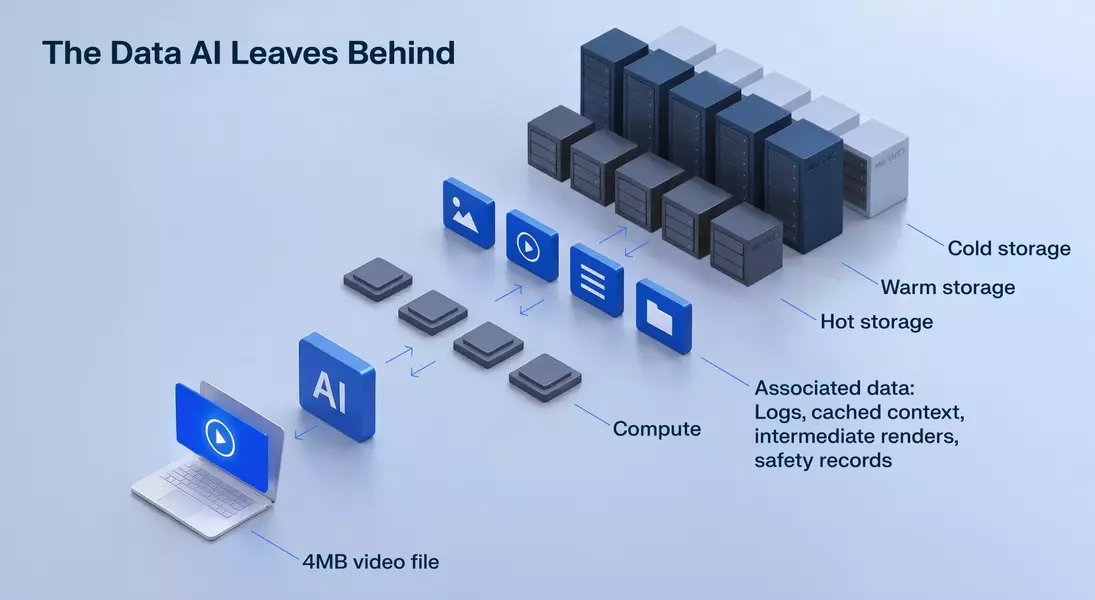
The growth of AI-driven inference, which is the process of using a trained AI model to make predictions or decisions, is a continuous and data-intensive activity. Unlike model training, which has a defined start and end, inference operates perpetually, generating persistent data with each interaction. For instance, an eight-second AI-created video, while appearing compact to the user, can leave hundreds of megabytes of associated data in the backend, including logs, cached information, temporary renders, backups, and crucial safety records. When scaled across enterprise-level operations producing longer, higher-resolution content, this backend footprint can balloon to hundreds of gigabytes per clip, representing a monumental increase over the user-facing output size.
Market projections underscore the urgency of addressing this issue, with AI inference demand anticipated to experience a compound annual growth rate of 35% through 2030. This rate significantly outpaces the projected growth for training, indicating that inference will constitute over 40% of total data center demand by the end of the decade. A recent industry survey further revealed that nearly 95% of businesses have seen an increase in data volume due to generative AI in the last year, with more than 60% reporting growth exceeding 25%. Such rapid expansion highlights a critical challenge: if storage expenditures continue to climb at this pace, they could quickly overshadow compute budgets, which typically follow more predictable cycles.
The increasing volume of retained data also redefines its role. Information previously destined for static archives, rarely accessed, now serves as valuable input for future AI workloads. As more data is retained, retrieved, and reused, storage solutions must not only provide expanded capacity but also facilitate dynamic access. The demand for quicker archive retrieval to support inference and retrieval-augmented generation (RAG) is paramount, with a vast majority of businesses expecting this need. Consequently, AI workloads necessitate a delicate balance between performance and capacity. For the immense quantities of data that require long-term retention and frequent revisitation, high-density hard disk drives (HDDs) offer a cost-effective and high-capacity foundation, providing a significant advantage in terms of cost per terabyte.
From a financial leadership perspective, the definition of AI infrastructure spending is often too narrow, concentrating almost exclusively on computational resources. However, an idle AI model awaiting data access is just as costly as one awaiting a GPU. The storage bottleneck, unfortunately, often remains undetected until it manifests as operational inefficiencies and retrieval delays, rather than being a clear capital expenditure line item alongside accelerators. For example, a retail company generating AI-driven product videos or an insurance firm utilizing RAG for claims processing might meticulously budget for compute costs, but the compounding storage expenses for every video and processed claim can become a substantial, unanticipated cost. What initially seems like a minor storage 'rounding error' can, within a year or two, evolve into a significant portion of the overall program cost, particularly when leadership is evaluating future expansion.
To tackle this challenge effectively, architectural considerations are crucial. Current storage strategies frequently prioritize expensive, high-performance tiers for instantaneously accessed data, yet the bulk of AI data accumulates in less active, cooler tiers. What organizations truly require is economically scalable capacity: an infrastructure meticulously designed for the entire AI data lifecycle. This involves striking a balance between performance, storage capacity, energy consumption, system reliability, and overall ownership costs, especially as data continues to accumulate and is increasingly repurposed. It means recognizing that previously archived data can become active assets for RAG and inference, and that retention policies should reflect the evolving strategic value of data rather than merely its initial storage cost. Moreover, storage decisions must be made holistically, considering entire fleets of devices rather than individual units. Implementing a tiered storage system that optimizes individual power consumption, reliability, density, and operational efficiency is essential to maintaining economic sustainability as storage needs grow. Crucially, organizations must thoroughly assess their data retention policies for AI-generated content, evaluate whether storage procurement aligns with the actual data lifecycle rather than just training performance needs, and determine if doubling AI usage would proportionally double or excessively increase storage costs. Addressing these questions proactively before the next budget cycle is vital for sustainable AI integration.