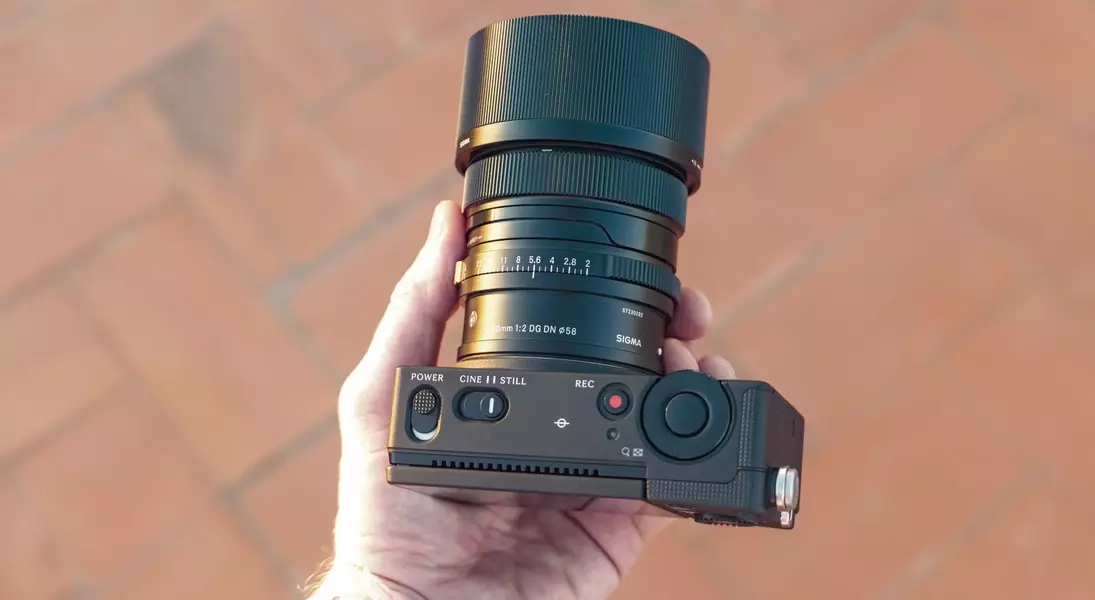
The Sigma FP2 stands out as a groundbreaking addition to the full-frame mirrorless camera market, continuing Sigma's commitment to creating the most compact devices in this category. This model introduces significant enhancements over its predecessor, including improved battery life, a versatile tilt screen, and substantial built-in memory. It excels in both still photography, capturing sharp 24.5MP images, and videography, offering impressive 6K open-gate recording capabilities. While its compact form necessitates modular accessories and lacks in-body stabilization, the FP2's design and user interface offer a remarkably intuitive and enjoyable shooting experience. Its blend of advanced features and unique design caters to those who value portability and high performance in a single package.
This review delves into the Sigma FP2’s innovative design and improved performance, highlighting how it balances its diminutive size with powerful photographic and videographic capabilities. We’ll explore its pricing structure, which, while initially appealing, becomes more substantial with necessary accessories. The article also examines the camera’s specifications, its user-friendly interface, and the quality of its output. Special attention is given to its autofocus system, video recording options, and practical considerations for its use in various shooting scenarios. Ultimately, the FP2 redefines expectations for compact full-frame cameras, offering a unique proposition in a competitive market.
Refined Design and Modularity of the Sigma FP2
The Sigma FP2, an evolution of the smallest full-frame mirrorless camera, enhances its predecessor's legacy with a more compact form factor and crucial upgrades. It features an efficient 24.5MP full-frame sensor, shared with models like the Nikon ZR and Lumix S1 II, enabling superior 6K open gate video recording and crisp 24.5MP stills. The camera boasts a significantly improved hybrid phase-detection autofocus, claiming a 15% boost in speed and accuracy. Additionally, it integrates 70GB of internal storage and a higher-capacity battery, aligning with modern Lumix full-frame cameras for extended shooting times. These advancements are encased in a durable metal chassis, maintaining a simple yet effective user interface that distinguishes photo and video functionalities intuitively. Despite its advantages, the FP2, like its predecessor, omits in-body image stabilization and a built-in viewfinder, necessitating optional accessories for optimal use.
While the Sigma FP2 continues to champion its ultra-compact design, its true potential is unlocked through a suite of modular accessories. The absence of in-body image stabilization means users must consider external stabilization methods, such as gimbals or post-production gyro data processing, for smooth video. The lack of an integrated viewfinder is addressed by an optional 5.76m-dot tilt EVF, which, while excellent, adds to the overall investment. This modular approach allows for customization but impacts the initial budget-friendly appeal. The camera's robust build and intelligent power management, featuring a high-capacity battery, ensure reliability during prolonged use. The innovative internal memory complements its external storage options, offering flexibility in handling various media formats. This design philosophy, though requiring additional purchases, caters to professionals and enthusiasts seeking a highly adaptable and portable full-frame system.
Advanced Performance and Practicality of the Sigma FP2
The Sigma FP2 incorporates a 24.5MP partially stacked full-frame CMOS sensor, a component previously seen in other high-performance mirrorless cameras, but it distinctly lacks in-body image stabilization. This characteristic makes achieving stable handheld video particularly challenging, often requiring external tools like gimbals or reliance on post-production software utilizing gyro data for stabilization. Despite this, the camera delivers outstanding image and video quality, capturing 6K open gate video at up to 60fps and 4K slow motion at 120fps. It offers a variety of 13 color profile presets, including a Log profile for extensive post-editing, catering to diverse creative needs. The autofocus system has been notably refined, offering enhanced speed and broader subject tracking capabilities, making it more reliable for dynamic shooting scenarios. Furthermore, its generous 70GB of usable internal memory streamlines workflow, though recording RAW video still necessitates an external SSD due to file size demands.
From a practical standpoint, the Sigma FP2 excels in its intuitive user interface, which clearly separates photo and video modes, simplifying operation. The camera's physical design, characterized by a flat front, means it lacks a traditional handgrip, which might impact handling with larger lenses. However, its modular construction is a significant advantage, allowing users to tailor the setup to specific tasks; for instance, the optional tilt electronic viewfinder (EVF-21) can be attached for photography while being omitted for video to maintain a minimal profile. This adaptability, combined with a robust battery life comparable to larger Lumix models, underscores its efficiency. While the initial body-only price is attractive, the necessity of these costly accessories for a comprehensive shooting experience should be factored in. Overall, the FP2 offers a refreshing and distinct shooting experience, making it particularly appealing to creators who prioritize a compact form factor and modular versatility.